
How MUD Games Work: Commands, Worlds, and the Engine Explained
A MUD game works through a continuous command loop: you type an action, the server parses it, updates the shared world state, and returns descriptive text to your screen. That cycle repeats in milliseconds. The world runs continuously whether you are logged in or not, which means timing, other players, and world persistence all shape every session in ways that no single player controls.
Understanding this loop makes the whole genre click into place. If you are brand new to MUDs, our introduction to what a MUD game is covers the basics before you dive into the mechanics here. For context on where these systems came from, see the history of MUD games.
The Command Loop: How Every Action Works
Most modern games hide their input loop behind buttons, animations, and menus. MUDs expose it directly. Every action you take follows the same four-step cycle, and once you understand it, the rest of the mechanics fall into place.
The loop works like this:
- You type a command (look, attack bandit, say hello, give bread to guard)
- The server parses it (identifies the verb, target, and context)
- The server updates the world (moves items, changes health, triggers events)
- You receive output (descriptive text, plus structured data your client can use)
That cycle can complete in milliseconds. When MUD combat feels real-time even though you are typing, it is because the server runs continuously. Your commands are events injected into an ongoing simulation, not turns in a queue waiting for your input.
Server vs. Client: Who Does What
The server is the authority on everything. It stores the world state, enforces all rules, and decides what is valid. Your client is the interface you use to communicate with it, nothing more. This distinction matters because it means no amount of client-side trickery can change what the server allows.
| Step in Play | Where It Happens | What It Means for You |
|---|---|---|
| You type a command | Client | Your client sends the text to the server over a live network connection. |
| The server interprets it | Server | The server checks rules, permissions, and context: is that item here? Are you stunned? |
| The world changes | Server | The server updates the persistent world state simultaneously for every connected player. |
| You see the results | Client | Your client prints the text output and may update UI elements if it receives structured data. |
How MUD Games Parse Commands
Parsing is the process of converting raw text into an action the game can execute. When you type a command, the server runs it through a series of checks before anything happens in the world.
Most MUDs follow a verb-first pattern. Commands look like:
look
look at statue
get gold
kick bandit
give bread to guard
Under the hood, the server typically asks four questions in sequence:
Is this a valid command? Does the verb exist in this game?
Is it allowed right now? Are you stunned, silenced, on cooldown, or otherwise restricted?
What is the target? If there are two bandits in the room, which one do you mean?
What systems does it touch? Combat, inventory, movement, dialog, crafting, or some combination?
MUDs feel strict by modern standards partly because of this explicit parsing. The upside is consistency. Once you learn the command language of a specific world, your inputs produce predictable results. The interface stops feeling like a wall and starts functioning more like a fluent conversation.
Persistence: The World Keeps Running When You Log Off
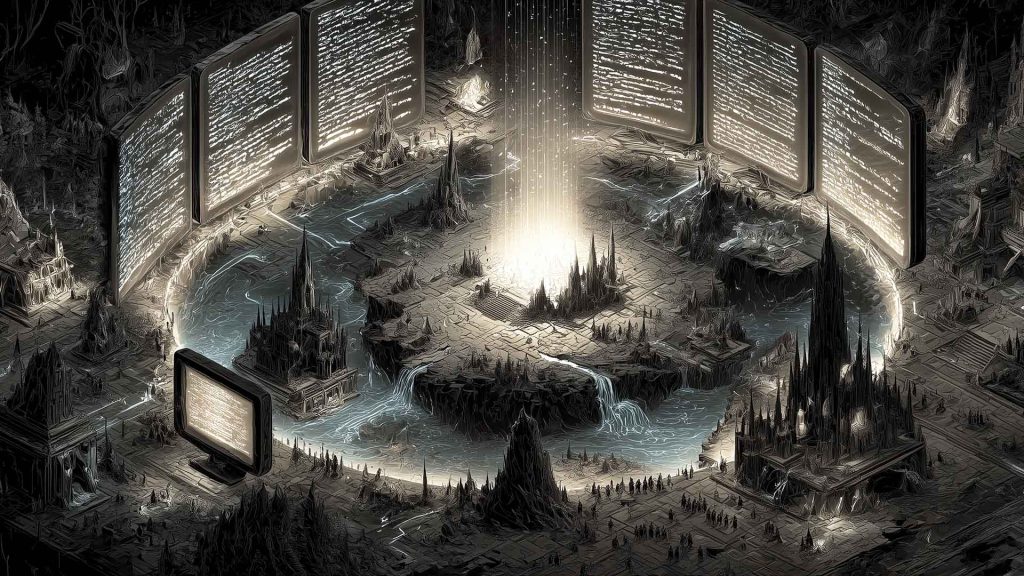
“Persistent world” has become a buzzword in gaming, but MUDs invented the concept and built it into the core architecture. The game world continues to exist and evolve whether or not you are connected. Shops can sell out of stock. A war can redraw political borders. Another player can pick up an item you dropped hours ago.
This is a fundamental design choice, not a feature bolted on afterward, and it changes how every system in the game feels. Time carries weight because events are scheduled, seasons rotate, and political situations shift. Your reputation persists because the people and systems around you remember what you did. Long-running projects like crafting economies, city construction, and faction politics become genuinely meaningful because they accumulate over months and years, not sessions.
Persistence is a significant part of why MUD communities feel different from those in most online games. The world is more like a place with its own continuity than a match you queue into and leave behind. For a longer look at this dynamic, see why play MUD games.
Combat Timing: Ticks, Cooldowns, and Balance States
A common assumption about text-based combat is that it must be turn-based, like a tabletop game with typed moves. Some MUDs work that way, but many run on a continuous timeline governed by timing constraints that function like cooldowns.
Ticks are regular time pulses the server uses to process scheduled updates: healing, hunger, weather changes, resource regeneration. A tick is essentially the server running a batch of periodic tasks.
Cooldowns are delays before you can repeat an action, sometimes called “recovery.” After executing a move in combat, you may need to wait a fraction of a second before you can execute another.
Balance and equilibrium are game-specific readiness states that prevent instant action spam. Think of them as stamina gates applied to specific categories of actions rather than a single shared pool.
These systems explain something that often surprises new players: experienced players look faster without typing faster. They are sequencing actions around timing rules, choosing which abilities to chain together and when, not racing the keyboard. The skill in MUD combat is closer to strategic sequencing than reflex speed.
MUD Clients: Triggers, Aliases, and Scripts
Your client is the program you use to connect to a MUD. It can be as simple as a terminal window using a Telnet connection, or as sophisticated as a dedicated application with tabbed panels, an in-game map display, health bars, and a full scripting engine. Modern Iron Realms games also offer a browser-based client, so you can play without installing anything.
Beyond displaying incoming text, most serious clients support three categories of automation:
Aliases are shortcuts that expand into longer command sequences. You might type two characters and trigger a multi-step combat routine.
Triggers are rules that react to text patterns automatically. A trigger follows an “if you see X, do Y” logic. If the game outputs a line containing “You are poisoned,” a trigger might automatically execute the cure command. Triggers commonly use regex, a pattern-matching syntax, to match variable text reliably.
Variables are stored values your client remembers across commands, like a target name or resource count, so scripts can reference them without re-entering the information each time.
Scripts and Fairness
The question of scripting and fairness comes up in every MUD community. Different games land in different places. Some treat scripting as normal skill expression and provide tools to support it. Others restrict it to varying degrees. What holds true everywhere is that the server remains authoritative. A client can only send commands you could have typed. It just helps you send them quickly, consistently, and in better sequence.
Out-of-Band Data
Some MUDs transmit structured data alongside the narrative text stream, often called out-of-band data. This lets clients display real UI elements like health bars, affliction trackers, and minimap panels without scraping them from prose descriptions. Games that support this tend to have smoother client integrations and fewer brittle triggers that break whenever the wording of an in-game message changes slightly.
The Gameplay Loop You Will Actually Experience
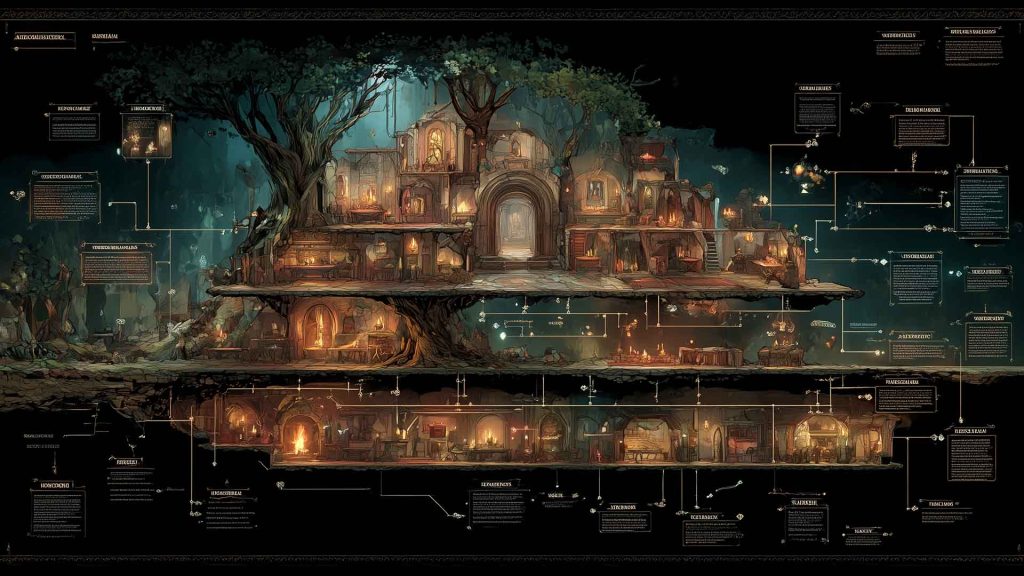
In practice, playing a MUD settles into a repeating rhythm across four broad activities. The specific content changes, but the rhythm stays consistent.
Explore. Move through rooms, learn the geography, find points of interest, and build your mental map of the world.
Interact. Talk with other players, trade goods, join organizations, pick political sides, and build relationships that carry weight over time.
Progress. Gain skills, improve your character, unlock access to new areas or abilities, and build up resources and influence.
Respond. Handle threats, act on opportunities, and deal with the social consequences of your own choices as the world shifts around you.
What makes this loop hold up over years is that the content feeding into it comes from two sources: the game’s own systems and other people. The combination of deep mechanics and a persistent social environment means there is rarely a defined end state. The world keeps changing, and so do the things worth doing in it.
If you want to see this loop in action, all Iron Realms games are free to play with no download required. See 30 MUD games that define the genre for a broader selection across different styles.
Common Misconceptions About How MUD Games Work
“It is basically a group chat with dice.” There is often rich narrative, but the underlying simulation is closer to an MMO engine than a chat room. Combat systems track dozens of variables. Economies have supply and demand. Political systems accumulate history.
“You have to type fast to be competitive.” Timing, preparation, and decision sequencing matter far more than words per minute. A well-prepared player with a good alias setup will outperform a fast typist who does not understand the timing rules.
“Automation plays the game for you.” Scripts reduce repetitive busywork, but strategic positioning, target prioritization, and social awareness remain entirely human problems. The server enforces limits, and no script replaces judgment.
What Makes a MUD Feel Good to Play
If you are evaluating a game and trying to understand why it does or does not click, the answer usually comes down to a few consistent factors.
Clarity of feedback. You can tell why something happened, not just that it happened. Good MUD output tells you which action triggered which result.
Consistency of language. Commands and messages behave predictably. The same verb does the same thing in similar contexts. When the game breaks this, it loses trust quickly.
Meaningful persistence. Your actions leave traces. An economy you influenced, a political faction you helped build, a location you helped create: these should still exist next month.
Room for mastery. You can improve through knowledge, planning, and social intelligence, not only through grinding stats. The best MUDs reward understanding the systems as much as they reward time spent.
When those elements are present together, the text interface stops feeling like a limitation. It becomes a direct control surface with no visual clutter between your intent and the world’s response.
Frequently Asked Questions
Do MUD games run in real time or turns?
Both models exist, but most modern MUDs run on a continuous timeline with timing constraints like cooldowns or balance states. You can act whenever the system allows you to, and the server processes commands as events. In practice, this feels real-time even though you are typing rather than clicking.
Is a MUD server basically an automated Dungeon Master?
Functionally, yes, with one important difference: it is deterministic code enforcing rules at scale rather than a person improvising at a table. A tabletop DM makes judgment calls on the fly; a server simulates and validates. The analogy is still useful because you are describing intentions and receiving narrated results, which is the same basic contract as tabletop roleplay.
What are triggers in a MUD, and are they considered cheating?
A trigger is a client-side rule that reacts to text patterns automatically, following an “if you see X, do Y” logic. Whether triggers are considered normal play, encouraged, or restricted varies by game. Iron Realms games treat client scripting as part of normal skill expression. Regardless of policy, the server remains authoritative and can enforce its own limits on action timing and frequency.
Why do MUDs feel difficult to understand at first?
Because you are learning a command language and a world at the same time, without a visual interface to guide you. Most games hide complexity behind icons and menus; MUDs expose it directly. Once you internalize the core verb patterns and recognize the feedback signals the game sends, the friction drops significantly. Early confusion is common and does not predict whether you will enjoy the game.
Ready to try the engine for yourself? Play an Iron Realms MUD free, or browse 30 MUD games that define the genre to find a world that fits your style.