
MUD Culture and Community: Why Text Worlds Build Stronger Bonds
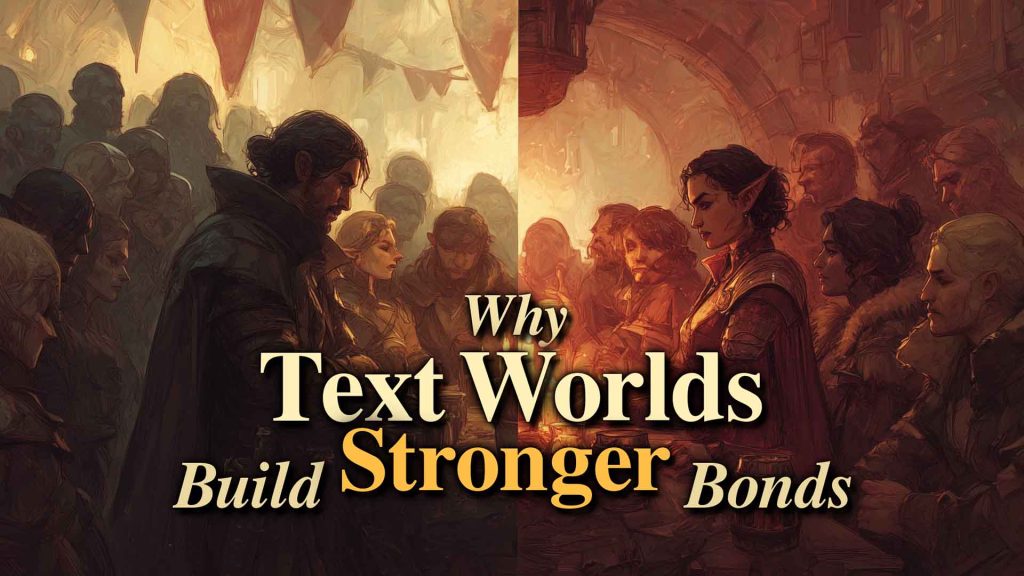
MUD communities feel different from most online games because the structure of a text-based world makes social behavior matter more. Smaller populations mean persistent identity: the same names appear for years, reputation accumulates, and player actions have visible consequences. Other players become the real content, and the culture that develops around that tends to reward memory, etiquette, and written self-expression over speed or spectacle.
Understanding why requires looking at what MUDs actually are. A MUD is a shared online world presented through text, where players move through rooms, fight, trade, roleplay, and build long-term relationships. If you are new to the genre, our introduction to what a MUD game is covers the foundations. For the social side specifically, read on.
Persistent Identity: You Are Not Just Passing Through
In many modern online games, you can drift between servers, queue into anonymous groups, and leave almost no social footprint. A MUD works differently. Your character is persistent, your name is public within the community, and the same people keep appearing. That changes behavior quickly.
When a population is small enough that people remember who negotiated badly, who mentored newcomers, who broke a promise, or who kept a city running through a crisis, the game stops feeling like a lobby. It starts feeling more like a town. A single text MUD can produce deeper interpersonal bonds than a much larger graphical world precisely because scale does not allow anonymity to dissolve accountability.
MUD Culture vs. MMO Culture: A Comparison
| Feature | Text Culture (MUD) | Graphic Culture (MMO) |
|---|---|---|
| Anonymity Level | Low. Server populations are small. Names, history, and reputation persist across months and years. | High. Cross-server queues and large populations let most players disappear into the crowd. |
| Developer Presence | Visible. Admins often exist as in-game figures who interact with players directly inside the world. | Invisible. Developers communicate through patch notes and community posts, rarely in-game. |
| Conflict Nature | Systemic. Theft, assassination, and political sabotage are valid mechanics built into the design. | Restricted. Systems are designed to minimize friction and protect players from one another. |
| Creative Agency | Co-author. Players write character descriptions, design guild halls, and craft in-game texts. | Consumer. Players select from a pre-set list of cosmetic options chosen by the development team. |
None of that makes one format better than the other. It does mean the social stakes are calibrated differently, and the cultures that grow up around them reflect that difference.
Why Writing Quality Matters More in a MUD
A text-based world pushes more of your personality onto the page. You are not relying on animations, gear visuals, or voice tone to carry presence. Words are the only signal.
That has two practical effects on community culture. First, players often become recognizable through tone, wit, diplomacy, and consistency over time. A character who writes sharp speeches, persuasive letters, or well-constructed arguments can gain genuine status in the community without being the strongest fighter on the server. Written skill becomes a form of social currency.
Second, communities tend to develop clearer norms around how people communicate. Not every MUD is literary, and plenty are casual in register. But language usually carries more weight here than it does in fast, interface-heavy games, and that shifts the overall feel of game culture. Many veteran players report remembering conversations, rivalries, and public debates more vividly than mechanical achievements. In some MUDs, the written record is part of the game itself: history books, political documents, and IC correspondence authored by players and stored in the world.
For more on the creative side of MUD play, see why play MUD games.
The Small-Town Effect: Social Memory in MUD Games
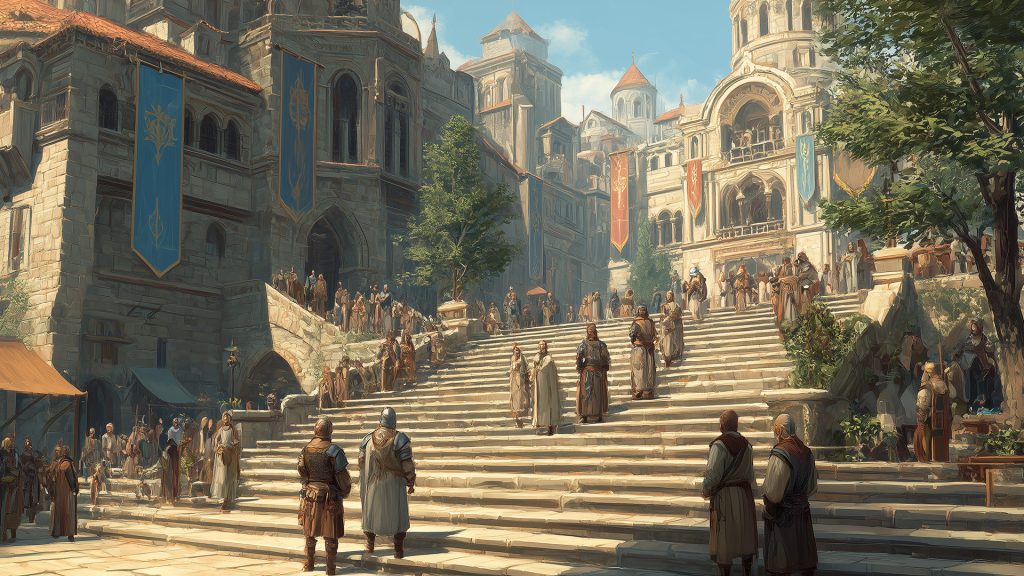
One of the most consistent features of MUD communities is social memory. In a large online game, a poor interaction can disappear into the activity feed within hours. In a smaller world, it persists. People remember who mentored new arrivals, who stole from allies, who abandoned their post during a crisis, and who handled power responsibly once they gained it.
That creates a culture with unusually high accountability. The upside is that trust means something real. Reliability, generosity, and competence become visible assets that accumulate over time. The downside is that old grudges can last for years, and a poor first impression sometimes requires sustained effort to overcome.
Experienced players often describe MUD life in civic rather than gaming terms. You are not only optimizing a build or completing a progression track. You are developing a public identity inside a long-lived community where others have watched you long enough to form genuine opinions.
In-Character and Out-of-Character: The Etiquette Line
A common surprise for players arriving from other online games is how seriously many MUD communities treat the distinction between in-character (IC) and out-of-character (OOC) behavior.
In-character means acting as your fictional persona inside the world. Out-of-character means stepping outside that fiction as the actual person at the keyboard. Different games draw the line in different places, but most established MUD communities care about maintaining it more than most other online spaces do.
That boundary shapes etiquette in concrete ways. A betrayal between characters may be entirely valid play, even celebrated as good storytelling. Personal abuse between the players behind those characters is a different matter. A player who runs a ruthless in-game tyrant can still be a respected community member if they keep that line clear. Many older communities take pride in being able to oppose a character fiercely while respecting the human behind the keyboard.
Related to this is metagaming, which means using information your character should not logically possess. In MUD culture, metagaming is usually treated as a serious breach because it undermines the shared fiction that everyone else is investing effort to maintain.
Why Politics Are Central to MUD Culture
MUDs give players more institutional responsibility than most people expect. The scope goes well beyond guild management. Players run cities, organize factions, write and enforce laws, handle diplomacy, recruit members, adjudicate disputes, and shape the local norms that govern how other players behave.
Shared administration is one of the main reasons MUD communities become unusually durable. When players govern each other, they develop shared memory, shared investment in outcomes, and conflict with real consequences for the community rather than just for individual characters. You do not need formal elections or legal systems for this to emerge. Even a relatively simple game can develop durable factions, patronage networks, rival cliques, and public expectations about leadership that persist for years.
Politics in MUDs are not decoration or side content. They are frequently the engine that turns a set of game rules into a lived world with its own history. For a deeper look at the history of how these systems developed, see the history of MUD games.
How Productive Friction Keeps MUD Communities Alive
A persistent assumption about strong communities is that they depend on consistent friendliness and cooperation. In MUDs, that is only part of the picture.
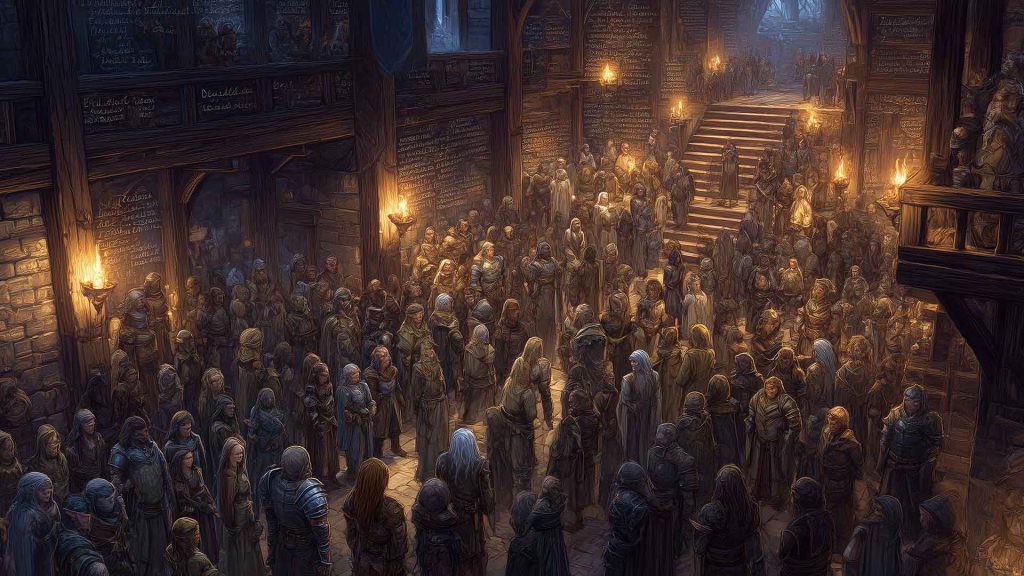
These worlds often stay vital because they allow, and in many cases actively support, productive friction. Rivalries, ideological splits, territorial disputes, duels, religious conflict, and public arguments all generate stories that keep players invested. The key word is legible: the conflict belongs to the world and is visible to the broader community, which means other players can respond to it, take sides, and build their own narratives around it.
This is a meaningful distinction from random toxicity. A culture built around conflict with in-world stakes can be dramatic, even harsh, without collapsing into empty abuse. The better communities learn to support conflict inside the fiction while protecting the basic social fabric outside it. When that balance holds, the world feels alive. When it fails, the community tends to fragment quickly.
The Technical Side of MUD Culture
One aspect of MUD culture that often surprises people from outside the genre is how much it intersects with tool-building and interface customization.
Many players use advanced clients: programs that connect to the game while adding features like maps, trigger automation, alias shortcuts, log files, and custom UI panels. In some communities, writing and sharing scripts becomes part of play in its own right. A trigger is an automated response to a line of text; an alias is shorthand for a longer command sequence. Advanced players build elaborate systems that let them respond more quickly, track more information, and manage complex responsibilities like city administration or large-scale combat.
None of this means every player needs to code. It does mean that MUD communities often include a culture of tinkering, interface design, and shared technical knowledge that most other game genres do not. Veteran players trade client settings, build tools for the community, and treat optimization as a craft with its own standards. For a more detailed look at how the client architecture works, see how MUD games work.
Common Misconceptions About MUD Communities
“Text games are less social because there are no graphics.” In practice, the opposite is often true. When text is the primary interface, conversation and written social presence become the main things players have to work with. The social dimension tends to be more central, not less.
“Everyone in MUDs is roleplaying constantly.” Some communities are roleplay-intensive. Others are casual. Many support a mix of combat-focused, politically focused, and roleplay-focused players in the same world. The culture varies considerably by game.
“Small populations mean weak communities.” Smaller populations often produce stronger recognition, longer social memory, and tighter bonds than massive ones. The strength of a community is not a direct function of its size.
What Keeps Players in MUD Communities
The most honest answer is not nostalgia. It is significance.
In many online games, progress means accumulating gear, levels, or checklist entries. In MUDs, progress often includes becoming known. Your relationships, the reputation you have built, the way you communicate, the loyalties you hold, and the public history you have created can matter as much to your standing in the game as your character sheet.
That is why MUD games hold attention across years and decades, even against competition from much larger and more visually sophisticated online worlds. They offer something many modern systems are designed to smooth away: the feeling that another person is actually responding to who you are, not just to the role the interface has assigned you.
For some players, that level of social exposure sounds demanding. For others, it is the core appeal. If you want to find out which category you fall into, all Iron Realms games are free to play, with no download required. You can also browse 30 MUD games that define the genre to find a community that suits your style.
Frequently Asked Questions
Are MUD communities friendlier than other online gaming communities?
Not by default. MUD communities can be welcoming, but they can also be demanding. The relevant difference is that behavior tends to have longer-lasting consequences in a smaller, persistent world. Trust and etiquette matter more because social memory is longer and anonymity is lower.
Do you have to be a strong writer to enjoy a MUD game?
No. You do not need to write like a novelist. You do need to be willing to communicate in text and pay attention to tone, context, and social cues. The bar for participation is low; the ceiling for written expression, if you want it, is high.
Why does reputation matter so much in MUD communities?
Because identity is persistent and populations are smaller than in most online games. When the same names appear over months and years, other players naturally form opinions based on accumulated experience. Memory becomes a structural feature of the social system rather than something you can reset by switching servers.
Are MUD games only for serious roleplayers?
No. Some MUDs are deeply roleplay-intensive, but many support a wide mix of playstyles: combat-focused, politically focused, economically focused, and casual social play. The culture of a specific game depends on its rules, its history, and the expectations its player base has developed over time. Iron Realms games in particular span a range of intensities.
Want to experience a MUD community firsthand? Play an Iron Realms game free, or explore 30 MUD games that define the genre to find one that matches what you are looking for.