
Why Play MUD Games? 7 Reasons Text Worlds Win
A MUD game is a persistent, text-based online roleplaying game where multiple players explore, fight, trade, and build stories in real time. MUD stands for Multi-User Dungeon. There are no graphics. The world is described in words, and you picture it yourself. That sounds like a limitation until you try it, at which point it tends to feel like the opposite.
MUD games have been running continuously since the first one launched in 1978. Iron Realms Entertainment has been building them since 1997. Our games, Achaea, Aetolia, Lusternia, Imperian, and Starmourn, are free to play and still actively developed. This page explains what keeps players coming back to them for years.
What Is a MUD Game?
A MUD game is a real-time, multiplayer online world that runs entirely in text. You type commands to move, fight, craft, and talk. The world keeps going whether or not you are logged in: cities change hands, economies shift, and players wage wars while you are away. If you want the full picture of what a MUD game is and how the format varies across different types of servers, we have a separate guide for that.
The short version: playing a MUD game is closer to reading a collaborative novel that you are also writing than it is to playing a video game. You can see the most influential MUD games ever made to get a sense of how far the medium reaches.
1. The “Graphics Card” Inside Your Head
In a modern graphical MMO, an art director has already decided what everything looks like. Your job is to watch it. In a MUD game, your brain does the rendering, and it does a better job than any GPU at producing images that feel personal and specific to you.
The ground shakes as a great dragon comes rushing in from the east, its great wings unfurled, buffeting you with great blasts of air.
The dragon you see in your head is exactly as large and terrifying as your imagination makes it. Nobody else’s version of that dragon is the same as yours. That is not a workaround for missing graphics. It is a feature that graphical games genuinely cannot replicate, because a rendered dragon is finite and yours is not.
Players often describe MUD games as more immersive than graphical games, not less. The screen is still just a window. Your mind is the actual world.
2. Be Anyone: Deep Character Customization
In most RPGs, customization is limited to a pre-defined kit of hairstyles and nose shapes. In the world of MUDs, you are the author. You are not limited by polygons or texture memory, which means you can look exactly how you want.
Deep Character Customization
In most RPGs, character creation means picking from a list of hairstyles, skin tones, and preset face shapes. In a MUD game, you write your character. You are not limited by polygon counts or what the art team had time to model, so your character can look, speak, and carry themselves exactly as you intend.
Other players see a description you write yourself when they look at you. You can have:
- Eyes the color of a stormy sea.
- A scar running down your left cheek from a dragon’s claw.
- Fingers stained with ink and magical reagents.
Acting with the Emote Command
Graphical games give you a menu of canned animations: wave, dance, bow. MUD games let you act through free-form emotes.
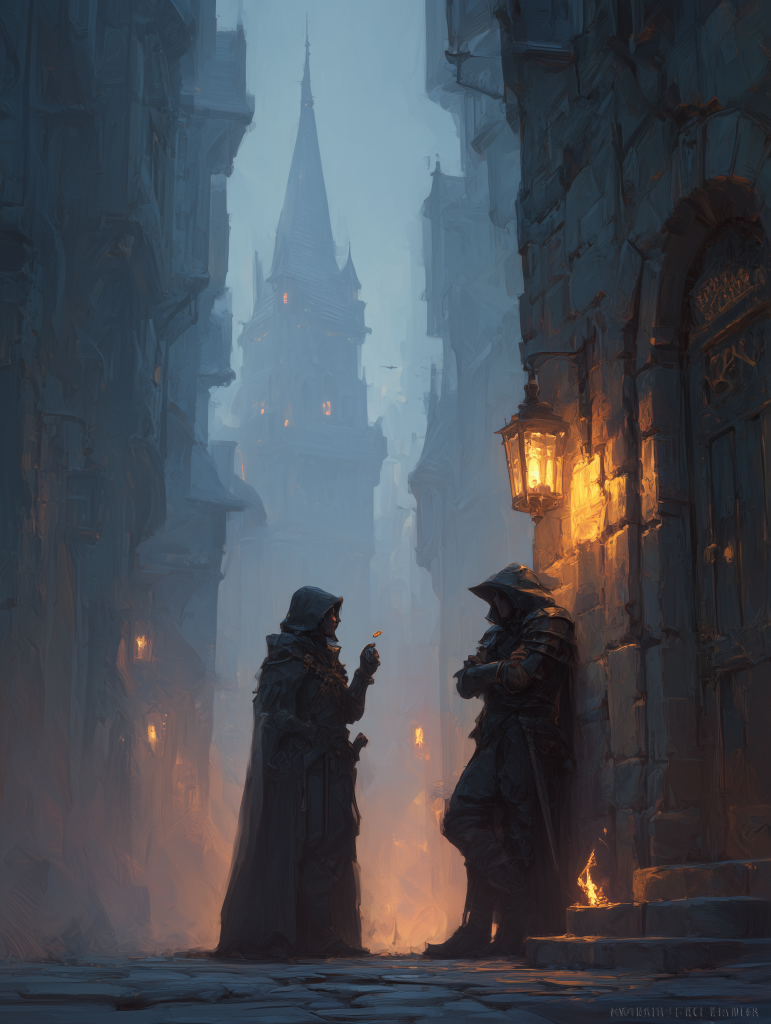
emote leans against the shadowy wall, flipping a gold coin nervously.
A cold stare, a nervous habit, a raised eyebrow mid-conversation: the kind of detail that 3D models rarely convey, MUD games handle in a single line. The different types of MUD games each have their own conventions for this kind of roleplay, ranging from combat-focused servers where emotes are light decoration to social servers where they are the primary activity.
3. Roleplay On Demand, Without the Scheduling Problem
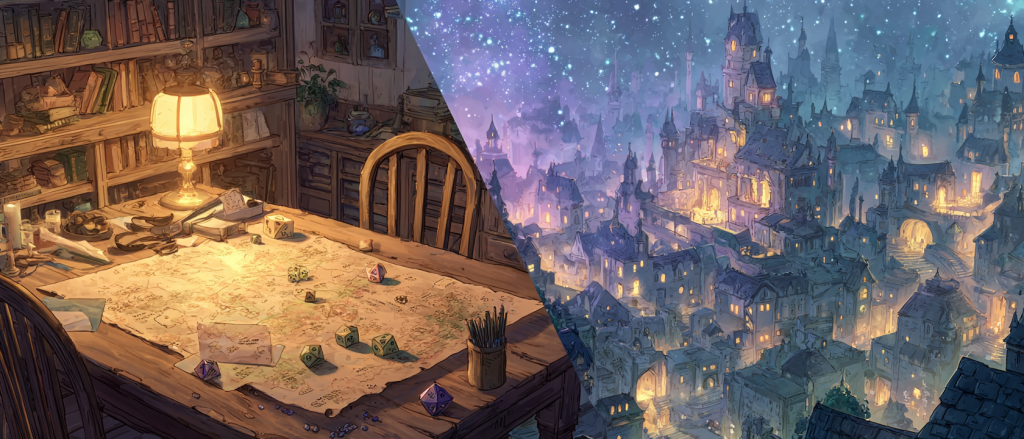
Tabletop games like Dungeons and Dragons offer deep roleplay, but they require everyone to be free at the same time. Coordinating a group of adults around a single evening is genuinely hard, and if someone cancels, the session falls apart. MUD games solve that problem by being available all the time, with players already in the world whenever you log in.
| Feature | Tabletop (D&D) | MUDs (Iron Realms) |
| Availability | Scheduled sessions only | 24/7 Persistent worlds |
| Players | Requires your specific group | Always someone online to interact with |
| Mechanics | Handled by the DM | Handled by the game engine |
| History | Limited to the campaign group | Written by the entire player base |
| Character legacy | Ends when the campaign ends | Persists permanently across years |
MUD games give you the social depth and narrative richness of tabletop roleplay without the logistics. The world is there whenever you want it. Your character and their history wait for you.
4. Deep Politics and Commerce: Players Run the World
OIn most online games, the King is a computer-controlled NPC with a few lines of scripted dialogue. In the best MUD games, the King is a player who ran a political campaign, built alliances, and won. That distinction changes how the whole world feels.
- The Law: Player leaders write and enforce the actual laws of their cities. Break them and face player-run consequences.
- War and Peace: City leaders can declare war on other factions. Those conflicts affect trade routes and player safety for months at a time.
- Religion: You can work your way up to High Priest, leading an order of real players who have chosen to follow your god.
- Commerce: Crafters write the descriptions for their own items. You can build a named product line, from “Gothic Wedding Dresses” to “Serrated Assassin Daggers,” and sell it across the economy.
Advanced players build custom aliases, scripts, and triggers to handle complex administrative or combat situations, turning their client into something more like a personal command center. A fuller explanation of the systems behind this is in our guide to how MUD games work.
5. MUD Game Communities That Know Your Name
MUD games have smaller, focused populations compared to mainstream MMOs. That constraint produces something you rarely find in large online games: a community where your reputation actually means something. Players call it the “Cheers effect.” If you are known as a trustworthy ally, people will go out of their way to help you. If you are known as a schemer, they remember.
New players get mentored by veterans, who were themselves mentored by players who may have quit years ago. That chain of shared history gives MUD worlds a texture that servers wiped and relaunched every year cannot produce. It is also why the same players return to Iron Realms games after five or ten years away and find people who still know their characters.
For more on what makes MUD game communities feel different from other online games, including the role of player-written lore, political factions, and the writing culture that develops around text worlds, there is a full guide on the topic.
6. Strategic Combat Without Reflex Requirements
MUD game combat is not a quick-time event. The fastest typist does not automatically win. It rewards timing, resource management, preparation, and prediction, and the layers of counterplay between skilled players can feel more like a chess match than an action game.
Because everything is text, players build their own setups over time: custom aliases, conditional triggers, and response logic that reflects how they personally play. That means getting better at MUD combat is genuinely tied to knowledge and decision-making rather than reaction speed. The skill ceiling is high, and reaching it takes real time.
Players coming from MMO backgrounds often find that the question of MUDs vs MMOs is less about graphics than they expected, and more about how deep the systems actually go.
7. Play Anywhere, Any Time, on Anything
Modern online games require a decent GPU, a large install, and the patience to sit through patches before you can actually play. MUD games run on a browser tab. They work on old laptops, slow connections, and split screens. You can log in during a lunch break, do something that matters to your character, and log out in fifteen minutes.
No loading screens. No shader compilation. No queuing to log in while the server is busy. Iron Realms games run in a web client with no download required, so you can go from reading this to playing your first MUD game in a few minutes.
Text Is a Flexible Interface
Text-based worlds adapt to how you want to use them. You can scale the font, change the color scheme, reroute alerts to specific windows, and tune the whole display around how you process information. Players who find graphical games visually noisy often find MUD games far easier to focus in for long sessions.
Because the game communicates in language rather than images, you also have more control over the pace of information. You read at your speed. You respond when you are ready.
MUD Games Remember What You Do
GGraphical MMOs tend to reset. Raid bosses respawn, story instances replay, and the world you left is the same one you come back to. In a MUD game, consequences accumulate. Wars change borders. Political coups replace ruling families. Players build structures that still stand years after the builder stopped logging in.
In the best MUD games, your character is not clearing content from a queue. They are building a history. The relationships, the rivalries, the things you built or destroyed, those persist in a way that makes returning feel different from loading a save file.
That accumulation of history is part of what makes the games that defined the MUD genre worth studying. Servers that have been running for twenty or thirty years have player-written histories that read like actual chronicles.
Ready to Start?
MUD games do not hand you the experience. They give you the tools to build one.
If you want a world where your choices leave a real mark, where the community has been around long enough to have a genuine history, and where the only limit on what you see is how vividly you can imagine it, the cursor is blinking.
If you want to explore which Iron Realms game fits you before diving in, the MUD games overview introduces the full catalogue and helps you pick.
FAQ: Why Play MUD Games?
What does MUD stand for?
MUD stands for Multi-User Dungeon. The name comes from the original MUD1, created by Roy Trubshaw and Richard Bartle at the University of Essex in 1978. It refers to a persistent, text-based online world with multiple players interacting in real time.
Are MUD games still active in 2026?
Yes. The longest-running MUD games have been going for thirty or forty years and still have active, regularly updated communities. Iron Realms games like Achaea, which launched in 1997, continue to receive updates and have players logging in daily.
Are MUD games free to play?
Most are free to start and free to play without spending money. Iron Realms games invented the free-to-play model for online games in 1997. You can play every Iron Realms MUD at no cost. Optional purchases exist for cosmetic and convenience items, and none of them create pay-to-win advantages.
Do I need special software to play a MUD game?
No download is required for Iron Realms games. They run in a modern web client in your browser. Players who want more control sometimes use dedicated clients like Mudlet or MUSHclient. For a full breakdown of how the software side works, see our guide to how MUD games work.
Are MUD games hard to learn?
There is a learning curve, and it varies by game. The best MUD games provide in-game tutorials, help channels staffed by veteran players, and systems that reward time spent learning. If you enjoy games where getting better actually requires understanding something, that curve is worth it.
What is the difference between a MUD game and a text adventure?
A text adventure like Zork is single-player, has a fixed story, and ends when you finish it. A MUD game is an online world with other real players, a live economy, social and political systems, and no scripted ending. The experience is much closer to an MMO than to Zork.
What are the best MUD games to play right now?
Iron Realms games are among the most actively maintained MUDs available: Achaea for high fantasy roleplay, Aetolia for a darker gothic setting, Lusternia for complex political systems, Starmourn for sci-fi. For a broader picture, see our rundown of the MUD games that defined the genre.
How do MUD games compare to MMOs like World of Warcraft?
MUD games typically offer more player control over world events, tighter community bonds, and no hardware requirements. MMOs offer visual production and faster onboarding. For a side-by-side breakdown of where each format wins, see the full MUD vs MMO comparison.