
Types of MUDs: MUD, MUSH, MUCK, and MOO Explained
The four main types of MUDs are MUD (systems and progression), MUCK (social hangout), MUSH (scene-based roleplay), and MOO (building and scripting). Each label signals what the world rewards when you log in. The boundaries blur — modern worlds blend features — but knowing these four terms tells you whether a world expects you to grind, write scenes, hang out, or build things.
You hear “MUD” and then someone says, “Technically it’s more of a MUSH.” That’s not gatekeeping. It’s shorthand for what the world prioritizes once you’re inside. Some text worlds feel like an MMO condensed into commands and systems. Others feel like live collaborative fiction, a social hangout, or a sandbox where building is the point.
A useful way to sort these worlds is to focus on two stable signals: what players do minute-to-minute (combat systems vs scenes and conversation), and who makes the content (staff-authored areas vs player-built spaces). Those two questions predict the vibe with surprising accuracy. If you want to go deeper on text worlds in general, see what is a MUD game or the history of MUDs.
Two questions that predict almost every variation
Instead of memorizing jargon, ask two questions. You can answer both by reading a world’s intro page or watching public chat for ten minutes.
Is play systems-first or story-first?
Systems-first means your primary loop is mechanical: leveling, builds, combat, crafting, economy, territory, optimization. Story-first means your primary loop is interaction: scenes, character arcs, social politics, collaborative plot, reputation.
Is content mostly staff-made or player-made?
Staff-made content means curated zones, quests, encounters, and designed progression. Player-made content means tools for building rooms, objects, and sometimes interactive behaviors, so the world grows from player projects.
These aren’t value judgments. They’re compatibility checks. New players most often leave a world because they picked one that rewards a different kind of attention than the one they showed up with.
At-a-glance: the four labels
| Label | Typical Focus | Content Source | Default Session Loop |
| MUD | Mechanics and advancement | Mostly staff-authored | Hunt, quest, train, optimize |
| MUCK | Social presence and spaces | Often player-built | Hang out, chat, RP lightly, customize |
| MUSH | Collaborative roleplay | Mixed, plot-driven | Schedule scenes, write RP, pursue plots |
| MOO | Building and scripting | Heavily player-created | Build, tinker, script, test and iterate |
Keep “typical” doing work here. A given world can drift from its stereotype, and hybrids are common enough that culture matters more than the acronym on the listing page.
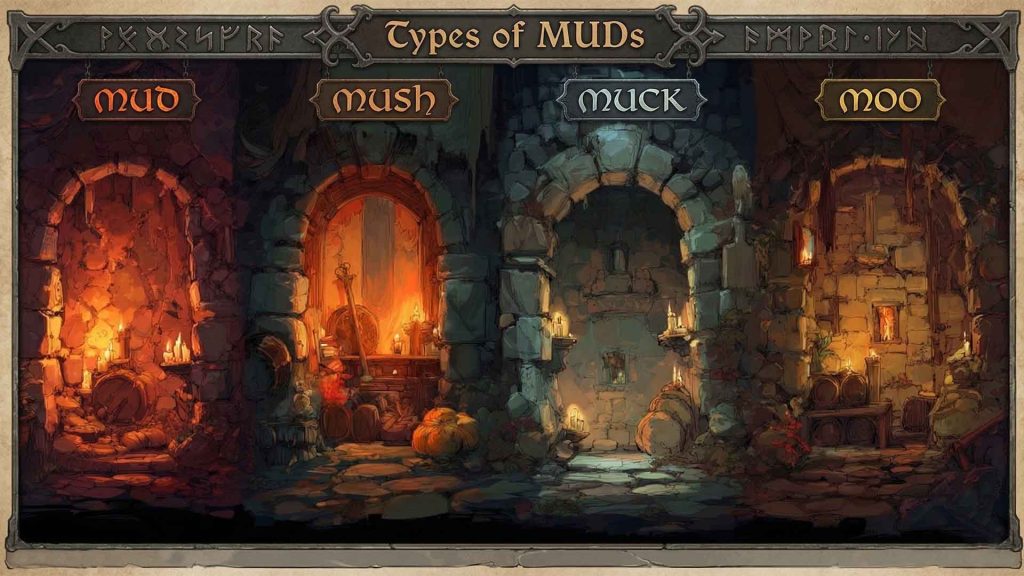
MUD: systems-first worlds with mechanics and progression
When people use “MUD” as a specific type rather than the umbrella term, they usually mean a world where the game loop is mechanical: you improve a character over time through structured systems. Think exploration, combat, advancement, economies, and increasingly elaborate toolkits for optimizing how you play. Iron Realms games like Achaea and Imperian are examples of this style, and you can try one free at play.ironrealms.com.
What you’ll commonly see: advancement systems (levels, skills, classes, professions), combat as a frequent activity with PvE or PvP as a core pillar, loot and crafting, resource loops, and social structures like guilds or factions.
How to spot it in five minutes: public chat includes build talk, training plans, group requests, and “where do I hunt next?” Public help files emphasize commands, skills, and progression. New players get nudged toward structured goals.
Why people stay: mastery and momentum. These worlds reward long-term skill — both in character build choices and player execution. The satisfaction of “my build is coming online” takes on a particular texture in text.
MUCK: social-first worlds and player-built spaces
A MUCK tends to be built around presence: being somewhere with other people, hanging out, and shaping spaces that feel like yours. Some MUCKs lean roleplay-heavy, others feel more like an always-open lounge with occasional scenes. Either way, the point is the people and the place you share.
What you’ll commonly see: a hangout culture with popular rooms that function like familiar meeting spots, flexible roleplay styles (in-character, casual, or mixed), player-built rooms or personal spaces, and identity and self-expression treated as a core activity.
How to spot it in five minutes: the busiest rooms are social hubs rather than leveling zones. Conversation and character presence dominate the scroll. People talk about spaces they made or events they’re hosting.
Why people stay: community and recognition. People notice when you’re there, remember what you’ve built, and treat your character like a real presence. See MUD culture and community for more on why this dynamic forms so reliably in text worlds.
MUSH: scene-based roleplay and character arcs
A MUSH is best understood as collaborative writing that happens live. Scene-based means you’re often writing a focused moment with one or more players — clear participants, a beginning and an end. You can still hang out, but the main course is scenes.
What you’ll commonly see: roleplay as the primary activity (often arranged or scheduled), strong norms around consent and etiquette, plot support that can be staff-run or player-run, and emotes or poses as the primary input rather than combat commands.
How to spot it in five minutes: players talk about “scenes,” “poses,” “plots,” or scheduling time. Help files emphasize roleplay norms and communication conventions. Mechanics, if present, feel like guardrails rather than the main draw.
Why people stay: character arcs and long memory. When you come back weeks later and someone references a small scene you forgot, you realize the world has been paying attention.
MOO: building and scripting inside the world
A MOO centers on creation tools, sometimes including in-world programming. Scripting means you can define how objects respond to commands, creating interactive behaviors. In many MOOs, building is not a side feature — it is the game, or at least half of it.
What you’ll commonly see: in-world building tools for rooms and objects, scriptable environments depending on the codebase, a tinkerer culture focused on experimentation and emergent systems, and social spaces that exist partly to support building collaboration.
How to spot it in five minutes: people share tools, prototypes, and building tips. The world feels like a workshop — lots of half-finished projects and clever utilities. New players are encouraged to make things, not just explore them.
Why people stay: invention. If you enjoy modding, building levels, or making tools, this branch of text worlds can feel unusually direct because the world itself is made of manipulable parts.
How to read a world’s homepage in under a minute
You can usually tell what you’re signing up for without deep research. Look for plain signals:
- Roleplay required, encouraged, or optional? That phrasing alone tells you whether scenes are expected.
- Levels, classes, skills, builds, or “endgame”? That’s systems-first language.
- Building tools, player spaces, housing, or creation? Creation-first.
- A code of conduct focused on roleplay etiquette? Scene-based culture.
- Scheduled activities like scenes, boss runs, or building nights? Look at what’s on the calendar — calendars don’t lie about priorities the way front-page copy sometimes does.
If the homepage doesn’t say, public chat will.
Codebase lineages: useful background, unreliable predictor
You’ll sometimes see terms in listings that refer to software lineage rather than play style. A codebase is the underlying framework the world runs on, and lineage names (DikuMUD, TinyMUSH, LambdaMOO, and others) are often used as shorthand in forum threads and mud listing sites.
These labels can hint at what a world might be good at, but two worlds sharing a code family can feel completely different because norms, moderation style, and player expectations diverge. A better test than any code label: what does the community reward? Efficient hunting, good scenes, beautiful spaces, clever tools, or political influence?
| On mislabeling: Lots of communities call everything a MUD. If the label conflicts with the vibe, trust the vibe. For a fuller picture of how these worlds evolved, see the history of MUD games. |
How to pick the right type without overthinking it
You don’t need to become a taxonomy person. You just need to avoid a mismatch between your attention style and what the world expects from you. A few questions worth sitting with:
- Do you want progress to be numeric (skills, gear, levels) or narrative (relationships, scenes, reputation)?
- Do you want to build things, or mainly experience authored content?
- Do you enjoy structured conflict (combat, competition) or negotiated conflict (scenes, social stakes)?
- How much performance energy do you have on a typical night?
One practical note: in a systems-first world, you can often socialize while you grind. In a scene-first world, it’s harder to half-participate, because other people’s time and emotional investment are on the line.
For a broader look at specific worlds across these categories, the 30 MUD games that define the genre is a useful companion to this guide.
Common misconceptions about types of MUDs
- Text-based doesn’t mean simple. The interface is minimal, but the underlying systems in a mechanics-forward MUD can be dense — sometimes denser than comparable graphical games.
- Roleplay-first doesn’t mean writing novels. Many MUSH communities prefer concise, readable scenes. The real requirement is mutual clarity and respect, not word count.
- The labels are strict genres. They’re not. “MUD” is often used as an umbrella term, and hybrids are common enough that culture matters more than what the listing page calls the world.
Frequently asked questions about types of MUDs
What are the main types of MUDs?
Most conversations come back to four labels: MUD (systems and progression), MUCK (social-first), MUSH (roleplay scenes), and MOO (building and scripting). They’re not strict genres, but they’re useful signals of what you’ll do when you log in.
What’s the difference between a MUD and a MUSH?
A systems-first MUD centers advancement and mechanics, with roleplay optional or secondary unless enforced by culture. A MUSH centers scene-based roleplay, where progress is character development and relationships rather than numbers.
How do I tell what type of MUD I’m in after logging in once?
Watch public chat and look at what newcomers are encouraged to do. If it’s “train, hunt, build,” you’re probably in a systems-first world. If it’s “scene, plot, pose,” roleplay-first is a good bet. If it’s “come hang out” or “check out my space,” lean toward social-first.
Is a MOO a game or a programming sandbox?
It can be either, and many are both. The defining feature is that creation is central: players build rooms and objects inside the world, and some codebases support scripting behaviors for those objects.