
What is a MUD Game? The Complete Beginner’s Guide
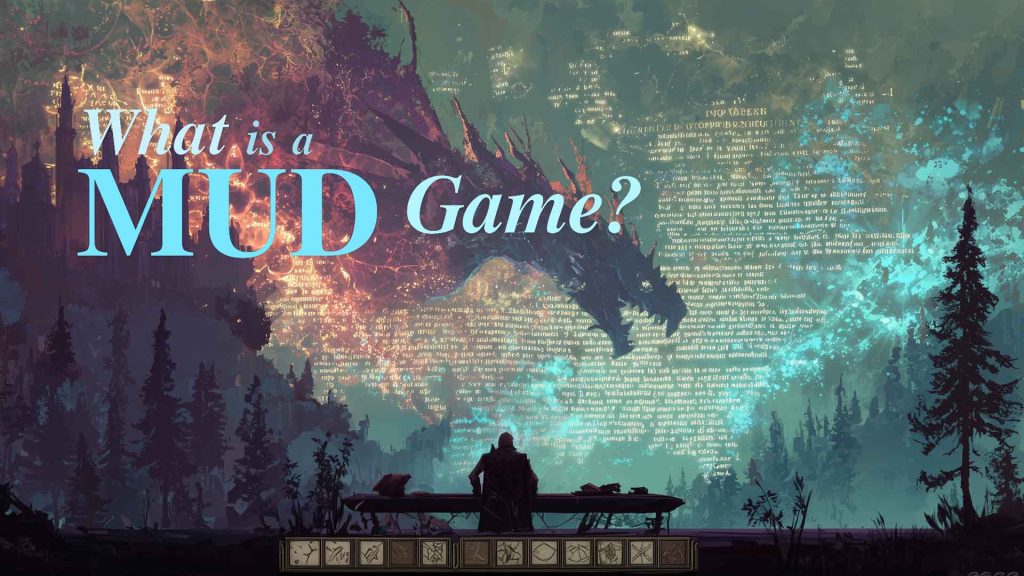
A MUD game, short for Multi-User Dungeon, is a text-based, multiplayer online roleplaying game. Players connect to a shared server, explore a persistent world described entirely in words, and interact with other players in real time by typing commands. There are no graphics. The world is written, and you picture it yourself.
MUD games have been running continuously since 1978, making them one of the oldest forms of online multiplayer gaming still actively played today. If you want to know why people still play MUD games in an era of high-end graphical MMOs, the short answer is depth: the kind that no rendering engine has managed to replicate.
What Does MUD Stand For?
MUD stands for Multi-User Dungeon. The name came from the original game, simply called MUD1, written by Roy Trubshaw at the University of Essex in 1978. Trubshaw and his collaborator Richard Bartle designed it as a shared text adventure where multiple players could explore the same dungeon at the same time. When MUD1 connected to ARPANET in 1980, it became the world’s first internet-accessible multiplayer RPG.
The acronym stuck even as the format evolved far beyond its dungeon-crawling origins. Today a MUD game might be a sprawling political fantasy world, a science fiction universe, a social roleplaying environment, or a combat-focused progression game. The word “dungeon” is mostly historical at this point. The “multi-user” part is still very much the point.
The Engine of Imagination
While the mainstream gaming industry chases photorealism, MUD games have persisted for nearly half a century by running on something no GPU can match: the human imagination.
Graphics, no matter how detailed, are a finite image defined by hardware. Text removes that ceiling. When you read a room description in a MUD game, your mind fills in the scene with a level of personal detail and atmosphere that no screen can produce. You are not watching the world. You are constructing it, and it is as vivid as your own thoughts allow.
This is why players often describe MUD games as more immersive than graphical games rather than less. To learn more about how that actually plays out in practice, see our guide to why play MUD games.
How Does a MUD Game Work?
The core loop of a MUD game is simple, but the systems underneath it can go very deep. A full technical breakdown is in our guide to how MUD games work, but here is the basic picture:
- Connection: You connect to a game server using a client. Iron Realms games run directly in a browser with no download. Dedicated clients like Mudlet give you more control over your interface and let you build custom dashboards.
- Input: You type natural language commands. look describes the room you are in. go north moves you. cast fireball at dragon starts a combat action.
- Calculation: The server maintains the full state of the world and calculates outcomes for combat, movement, crafting, and social interaction in real time.
- Output: The server sends back a text description of what happened.
Here is a short example of how that exchange looks in practice:
You see: The ancient dragon rears back, smoke curling from its obsidian nostrils.
You type:
You type: CAST FIREBALL AT DRAGON
The Game responds:
You chant the words of power. A sphere of roasting flame erupts from your fingertips, striking the dragon in the chest!
Modern MUD games go well beyond a scrolling text feed. Using protocols like GMCP, the server can send invisible data alongside the text, which your client uses to display health bars, minimaps, cooldown timers, and other graphical elements in a separate UI panel. An Iron Realms game running in the Nexus client looks more like a modern game dashboard than a 1980s terminal.
A Brief History of MUD Games
Four games in particular established the architecture that almost all MUD games still follow. For the full picture, see our dedicated history of MUD games article, which covers the genre from 1978 to the present.
MUD1 (1978): The Origin
Created by Roy Trubshaw and Richard Bartle at the University of Essex, MUD1 was the first game to let multiple players share the same text world simultaneously. When it connected to ARPANET in 1980 it became the world’s first internet multiplayer RPG, establishing the concept of a shared database of rooms that players could navigate and interact in together.
TinyMUD (1989): The Social Revolution
Where early MUDs focused on combat and scoring points, TinyMUD stripped those away entirely. Players built the world themselves, and socializing took over from winning. It pioneered what became known as the social MUD, where collaborative storytelling mattered more than any game mechanic.
DikuMUD (1990): The Combat Engine
Built at the University of Copenhagen, DikuMUD focused on structured combat: kill monsters, gain experience, level up. That loop was so well-designed that it became the direct template for MMOs like EverQuest and, by extension, World of Warcraft. Most of modern online RPG design traces back to a MUD from 1990.
LPMud (1989): The Builder’s Dream
Lars Pensjo built a system where administrators could write new content, add new areas, and push changes to players without ever taking the server offline. That concept, a live world that could grow while people were inside it, is still how Iron Realms games operate today.
Types of MUD Games
“MUD” is the catch-all term for text-based online worlds, but the genre breaks into several distinct formats with different priorities. The full breakdown is in our guide to types of MUD games, but the main categories are:
| Acronym | Full Name | Primary Focus |
|---|---|---|
| MUD | Multi-User Dungeon | Gameplay, Combat, Progression, and Questing |
| MUSH | Multi-User Shared Hallucination | Roleplay, collaborative storytelling, and social interaction |
| MOO | MUD, Object-Oriented | User-programming and social building |
| MUCK | Multi-User Created Kingdom | Social Interaction, often Furry/Anthropomorphic |
Iron Realms games are what players sometimes call IRE-style MUDs: a format that blends structured combat and character progression with the kind of deep roleplay more commonly associated with MUSH environments. The result is a world with real mechanical depth and a genuine social history.
Why Play MUD Games in 2026?
Playing a text game in an era of 4K graphics sounds like a step backward until you understand what MUD games actually offer that graphical games do not.
Community That Has History
Graphical MMOs tend to have large, anonymous player populations. MUD games have smaller, focused ones, and that changes how the social experience feels. Reputations form and persist. Veterans mentor new players. Rivalries develop over months. The communities that form around MUD games are unlike anything you find in a server with a hundred thousand faceless accounts, and many players describe the relationships they built in MUDs as the most meaningful ones they have formed online.
Living with the Gods
In Iron Realms games, the people who run the world do not just fix bugs from behind a support ticket system. They play as Gods. Pray to a deity and an admin logged in as that god might appear in a flash of lightning to grant a quest, deliver a prophecy, or curse you for your insolence. That kind of direct, improvised interaction between administration and players is a hallmark of the MUD format that no graphical MMO has managed to replicate at scale.
Political Systems That Actually Work
In games like Achaea, you can run for election to lead a city, set its tax policy, draft laws, or declare war on a rival faction. Those decisions affect other real players, and those players respond. It is closer to governing a small country than to playing a game, and it produces stories that no scripted content could generate. For a side-by-side comparison of how this stacks up against graphical MMOs, see our MUDs vs MMOs comparison.
Accessibility
Because MUD games communicate entirely through text, they are natively compatible with screen readers. Blind players participate in combat, roleplay, and political leadership on equal footing with sighted players. No other online RPG format comes close to that level of built-in accessibility.
Is a MUD Game Free to Play?
Most MUD games are free, and Iron Realms games in particular have been free to start since 1997. Iron Realms invented the free-to-play model for online games and still applies it the same way: full access to the game at no cost, with optional purchases for cosmetic items and convenience features that do not create pay-to-win advantages. You can start playing right now without entering payment details.
FAQ: What is a MUD Game?
What is a MUD game?
A MUD game, short for Multi-User Dungeon, is a text-based multiplayer online roleplaying game. Players connect to a shared server and interact with a persistent world by typing commands. The world is described entirely in text and exists continuously, whether or not any individual player is logged in.
What does MUD stand for in gaming?
MUD stands for Multi-User Dungeon. The name comes from the original game, MUD1, created by Roy Trubshaw and Richard Bartle at the University of Essex in 1978.
Are MUD games still active?
Yes. Some MUD games have been running for over thirty years with active, updated communities. Iron Realms games, including Achaea (launched 1997), continue to receive regular development and have players logging in daily.
Are MUD games free?
Most MUD games are free to play. Iron Realms invented the free-to-play model for online games in 1997. All Iron Realms games are free to start and free to play indefinitely, with optional purchases that are never pay-to-win.
What is the difference between a MUD and an MMO?
An MMO uses 3D graphics and typically has a large anonymous player population. A MUD game uses text, which allows for more complex systems, tighter communities, and deeper player agency over world events. For a full comparison, see our MUDs vs MMOs guide.
What is the difference between a MUD and a text adventure?
A text adventure is a single-player game with a fixed story that ends when you finish it. A MUD game is a persistent online world with hundreds or thousands of real players, a live economy, social and political systems, and no scripted ending.
Do I need to download anything to play a MUD game?
Iron Realms games run in a web browser with no download required. Players who want more control over their interface sometimes use standalone clients like Mudlet, but they are entirely optional.
What is the best MUD game for beginners?
Achaea is often recommended for new players because of its structured tutorial, active help channels, and broad range of playstyles. For a wider list, see our guide to the MUD games that defined the genre. For an overview of the full Iron Realms catalogue with a beginner recommendation section, see the MUD games overview.